

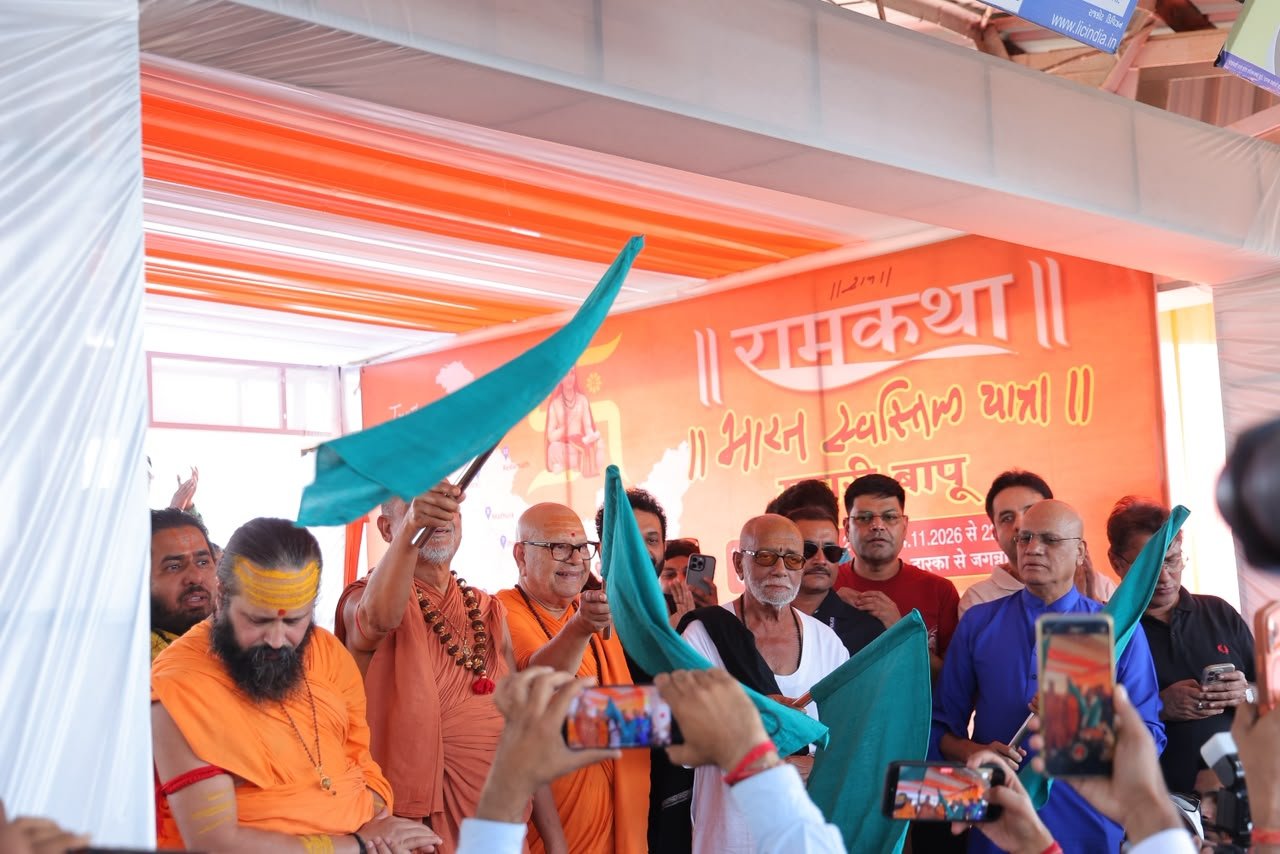
— First phase of Bharat Swastik Yatra Ram Katha was conducted from Kanyakumari to Kedarnath. Second phase starts at Dwarka and will conclude at Jagannath Puri.
DWARKA | 14th NOVEMBER 2026 | The Bharat Swastik Yatra, led by Pujya Morari Bapu, was flagged off from Dwarka today, marking the commencement of its second phase from Dwarka to Jagannath Puri. The occasion was marked by a press conference at Dwarka Railway Station in the presence of Ramcharitmanas exponent Pujya Morari Bapu and the Shankaracharya of Dwarka, Swami Sadananda Saraswati (Swami Sadananda ji Maharaja), along with other spiritual leaders, dignitaries, members of the organising committee and media.
The gathering marked an important milestone in the nationwide spiritual and cultural journey, which seeks to connect the length and breadth of Bharat through the enduring values of Sanatan Dharma. The second phase, scheduled from November 14 to 22, follows the successful completion of the first leg from Kanyakumari to Kedarnath between October 10 and 23.
Addressing the press conference, Pujya Morari Bapu said, “People often ask me whether I ever get tired of travelling so much. My answer is simple: a fan must keep rotating if it wishes to provide air to others. Similarly, as long as we have the strength and the blessings of our Peethas, we must continue travelling and serving. We have come to Dwarka to seek the blessings of this sacred Peeth.
During my earlier visit to Dwarka, I also visited Barwala Aarogya Dham and witnessed the remarkable service being rendered there for humanity. I felt inspired to contribute through a nine-day Ram Katha. I am delighted to announce that the Katha will be held in Dwarka from 16 to 24 October 2027, under the blessings of Bhagwan Dwarkadhish and the Shankaracharya Peeth. It is especially meaningful that the revered Pujari Ji of Dwarka will be the yajman for the first time.
The Bharat Swastik Yatra is not my idea; it is a divine thought and a Shiv Sankalp. We are undertaking this journey with the blessings of Bhagwan Mahadev and the revered Shankaracharyas. I feel privileged to receive the blessings of our spiritual leaders.
It is also beautiful that the flag of Jagat Mandir, Dwarka, will accompany us towards Jagannath Puri. From Jagat Mandir to Jagannath, this journey represents the spiritual continuity and unity of Bharat. May Bhagwan bless this endeavour and inspire us to work for the welfare of all.”
The presence of the Shankaracharya of Dwarka added spiritual significance to the occasion, bringing together two revered spiritual traditions as the Yatra embarked on its onward journey across the country.
His Holiness the Shankaracharya of Dwarka Swami Sadananda ji Maharaja said, “The second phase of the Bharat Swastik Yatra, beginning from the sacred land of Dwarka, will proceed towards Trilokya Sundar Jagat Mandir and be dedicated to Akhanda Brahmanda Nayak Prabhu Jagannath. This is the fruit of great deeds and an opportunity that comes through divine grace.
God has blessed us with a human birth, which is far more precious than any other form of life. He has not given us this life merely to exist, but to understand our purpose and fulfil our responsibilities. We must reflect on what we are meant to do and then act upon it. Our actions should rise above personal interests and contribute to the welfare of all.
Why do we come to Dwarka? Why do we listen to Ram Katha? Why do we undertake a pilgrimage to Jagannath Puri? We must understand the deeper purpose behind these journeys. Our faith, our Sanatan traditions and our spiritual journeys should inspire us to become better human beings and work for the larger good of society.
The Bharat Swastik Yatra is not an endeavour undertaken for any individual or organisation. It is an initiative for the welfare of all, carrying a message of harmony, collective well-being and the spiritual unity of Bharat. The arrangements and efforts behind this yatra are being made with the spirit of Sarvajan Hitaya, Sarvajan Sukhaya — the welfare and happiness of all.”
The press conference was followed by the first Ram Katha of the second phase at Dwarka, marking the continuation of Pujya Morari Bapu’s spiritual narration through the Bharat Swastik Yatra.
Around 1000 devotees are accompanying Pujya Morari Bapu in the second phase of the Bharat Swastik Yatra aboard two special trains — Kailash Bharat Gaurav and Chitrakoot Bharat Gaurav, comprising 22 and 16 coaches respectively.
Dwarka, revered as the ancient kingdom of Bhagwan Shri Krishna and one of the four sacred Char Dham pilgrimage destinations, holds a special place in India’s spiritual heritage, making it a fitting starting point for the Yatra’s second phase towards Jagannath Puri.
The second leg will travel from Dwarka through Somnath, Dakor, Ujjain, Nagpur, Champa, Mayapur and Kolkata before culminating at Jagannath Puri on November 22. The journey follows the first phase, which travelled from Kanyakumari through Kalady, Sringeri, Hampi, Tuljapur, Omkareshwar, Jhansi, Mathura, Kurukshetra, Attari-Wagah and Jammu before reaching Kedarnath.
Together, the two phases of the Bharat Swastik Yatra cover 13 Indian states and the Union Territory of Jammu and Kashmir.
The route also resonates with the geographical and cultural breadth evoked in India’s National Anthem, Jana Gana Mana, which refers to regions including Punjab, Gujarat, Maratha, Dravida, Utkala and Banga, alongside the Himalayas, the rivers Yamuna, Ganga, Mandakini and Alaknanda and the ocean. The Yatra connects with the Yamuna through Mathura and the Ganga through Rishikesh, while Kedarnath represents the Himalayan landscape and destinations such as Kanyakumari, Dwarka, Somnath and Jagannath Puri connect the journey with India’s coastal geography.
The journey draws inspiration from the spiritual legacy of Adi Shankaracharya, whose travels across the country helped connect its diverse regions through the philosophical and spiritual traditions of Sanatan Dharma.
The spirit of national integration is also reflected in the distinctive designs featured on the coaches of the two special trains undertaking the Bharat Swastik Yatra. Inspired by the cultural, historical and spiritual heritage of India’s states, the designs feature prominent personalities and iconic figures associated with different regions. Together, these visual representations celebrate the country’s diverse identities and shared heritage, symbolically reinforcing the central message of national unity.
Organised by Santkripa Sanatan Sansthan, the Bharat Swastik Yatra brings together spiritual leaders, Acharyas, scholars, udyogpatis, samajpatis, social leaders and community representatives, making the journey a collective expression of Bharat’s spiritual and cultural diversity.
Speaking about the vision behind the Yatra, Madan Paliwal, Chairman, Miraj Group and Managing Trustee, Santkripa Sanatan Sansthan, said, “The Bharat Swastik Yatra is an endeavour to bring people from different regions and walks of life together through our shared spiritual and cultural heritage. As it travels across Bharat, the Yatra reinforces the idea that while our traditions and identities may be diverse, our civilisational roots and values unite us as one nation.”
For Pujya Morari Bapu, whose Ram Kathas have consistently carried the message of Satya, Prem and Karuna—Truth, Love and Compassion—the Yatra is an extension of these values into a journey across Bharat. The Ram Katha and associated programmes during the Yatra remain open to all, with bhandara (vegetarian community meals) being organised at every location as prasad.
== ENDS ==

