

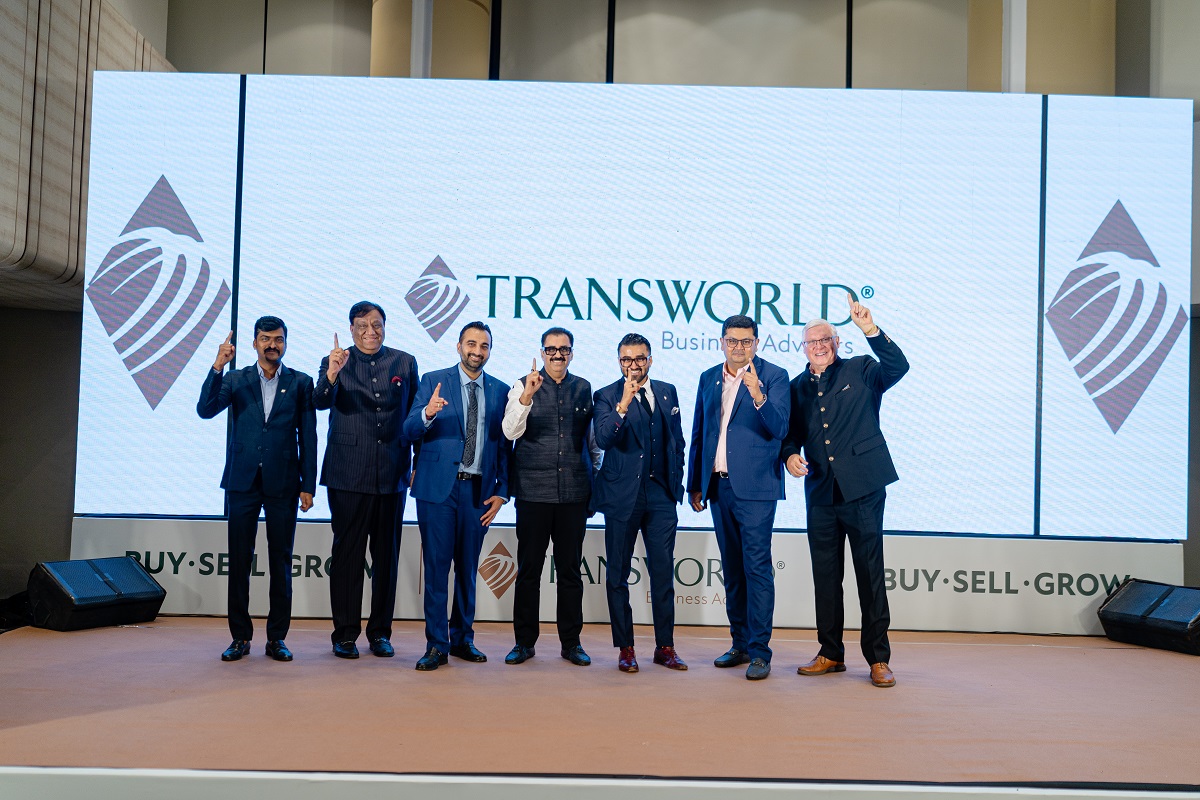
As succession, acquisitions and strategic exits move up the agenda, Transworld Business Advisors enters India to build a professional marketplace for buying, selling and transitioning businesses
AHMEDABAD, GUJARAT | 31st AUGUST 2026 | India has spent decades creating entrepreneurs. The next major opportunity may lie in what happens to the businesses they have built.
Across the country, thousands of founders have spent 20, 30 and sometimes 40 years building companies, creating employment, accumulating wealth and establishing businesses with meaningful enterprise value.
As these companies mature, their owners are beginning to face a different set of decisions.
Who takes the business forward? Should the next generation inherit it? Is it time to bring in capital or a strategic partner? Could an acquisition accelerate growth? And when the time is right to sell, how does an entrepreneur realise the value created over decades?
These are no longer isolated questions. They point towards a larger transition taking place across Indian business.
M&A activity is becoming increasingly strategic. Private capital has deepened. Acquisitions are becoming a more serious route to growth. And a generation of family-owned and founder-led businesses is approaching questions of succession, ownership and legacy.
India has become very good at starting and scaling businesses. It now needs an equally sophisticated ecosystem to value them, buy them, sell them and transition them well.
It is against this backdrop that Transworld Business Advisors (TBA), which describes itself as the world’s largest business brokerage, has launched in India.
TBA brings more than 45 years of operating experience and reports a global network of over 1,000 active brokers across 250+ offices, with more than 15,000 businesses sold.
TBA India will provide expertise across business sales and acquisitions, business brokerage, M&A advisory, valuations, succession and franchise consulting, with particular relevance to India’s privately held, family-owned and small and mid-sized business economy.
A large economy of businesses — and an emerging economy of ownership
The opportunity is particularly relevant to India’s enormous MSME ecosystem.
According to the Economic Survey 2025–26, MSMEs account for approximately 31.1% of India’s GDP, 35.4% of manufacturing output and 48.58% of exports.
Within this ecosystem sit established manufacturers, distributors, service companies, healthcare businesses, consumer brands and family enterprises with customers, employees, cash flows, assets, brands and decades of operating history.
Many have created significant enterprise value.
What has historically been less developed is an organised marketplace through which that ownership can change hands.
Yash Vasant, Chairman, Transworld Business Advisors India, said:
“India is approaching one of the most significant ownership transitions in its business history.
“We have become very good at starting businesses and increasingly good at scaling them. The next opportunity is to build an equally sophisticated ecosystem for what happens after they have been built.
“I want an entrepreneur who has spent 30 years creating a valuable company to know there is a professional market capable of valuing it, finding the right buyer and helping transfer what may represent the largest asset of his or her lifetime.
“Succession should become a strategy rather than a crisis. Entrepreneurs should consider acquiring great businesses rather than believing entrepreneurship must always begin at zero. And selling a business should be understood for what it can be — the realisation of decades of enterprise value.”
From revenue to enterprise value
For decades, the dominant entrepreneurial ambition in India was relatively straightforward: start a company, increase revenues and expand operations.
A maturing economy introduces another measure of success: what has actually been built, and what is it worth independently of its founder?
That changes the questions entrepreneurs ask.
Instead of relying entirely on organic expansion, a business owner may ask whether acquiring an established company could achieve in three years what building from scratch might take ten.
A founder approaching retirement may begin planning succession years before it becomes an emergency.
A second-generation entrepreneur may professionalise the business and prepare it for institutional capital.
Another owner may decide that after decades of building a valuable enterprise, it is time to sell and realise that value.
Vasant said:
“Revenue tells us how large a business has become. Enterprise value tells us what has actually been built.
“A truly valuable company should eventually be capable of surviving its founder, attracting capital, acquiring or being acquired, and successfully transferring from one owner to another.
“India has created an extraordinary generation of entrepreneurs. We now need to build the infrastructure that allows the value they created to compound beyond them.”
Building the marketplace around Indian businesses
TBA India’s ambition extends beyond facilitating individual transactions.
The company intends to help develop a professional national ecosystem connecting business owners, entrepreneurs, qualified buyers, investors and transaction advisers.
TBA’s global model supports owners and buyers through business valuation, confidential marketing, buyer identification and qualification, negotiations and transaction support.
The opportunity also changes the other side of entrepreneurship.
An entrepreneur does not necessarily need to start with a blank sheet of paper. Acquiring an established business can provide customers, employees, infrastructure, distribution and cash flows from day one.
Similarly, existing companies can use acquisitions to enter new markets, acquire capabilities or consolidate fragmented industries.
The entrepreneurial question therefore expands from simply “What can I start?” to “What can I build — and what can I buy?”
For Vasant, the ambition is ultimately larger than establishing a brokerage network.
“There are businesses you enter because a market already exists. And occasionally, there are businesses you enter because you believe a market is about to be created.
“For me, TBA India is the latter.
“India has built millions of businesses. Our ambition now is to help build the marketplace around them.”
== ENDS ==

