

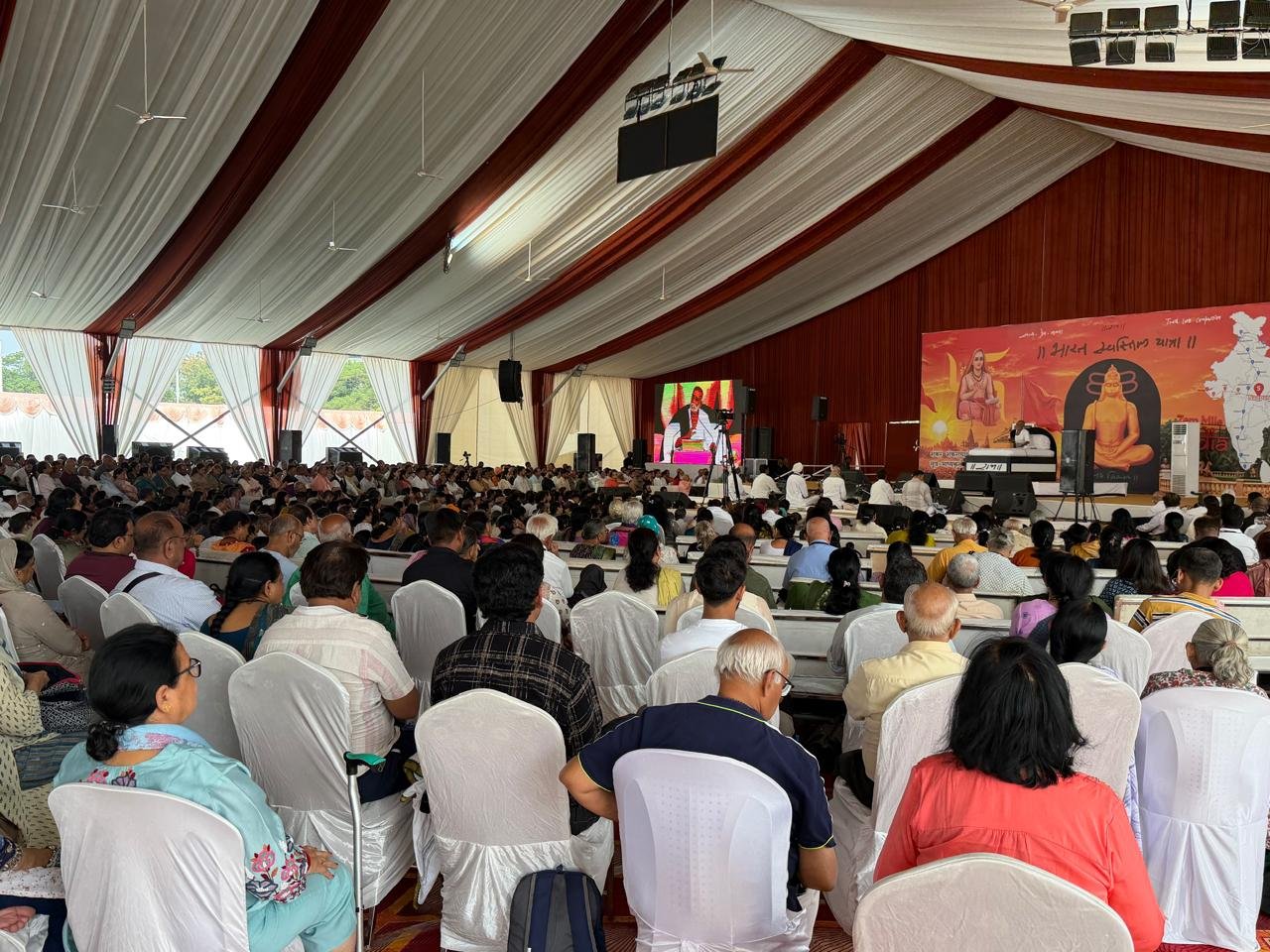
— Nagpur highlighted the city’s significance as a geographical landmark and an important political centre, home to the RSS headquarters, while reflecting on India’s spiritual traditions, social transformation and national integration.
NAGPUR, MAHARASHTRA | 18th NOVEMBER 2026 | The Bharat Swastik Yatra, led by Pujya Morari Bapu, reached Nagpur on November 18. A Ram Katha was held in the city as part of the Yatra, which has been connecting significant spiritual destinations across the country while highlighting the cultural and historical traditions that contribute to India’s shared civilisational heritage.
The Bharat Swastik Yatra’s second phase commenced from Dwarka on November 14 and travelled through Somnath, Dakor, Ujjain and Nagpur, before continuing towards Champaran in Chhattisgarh, Mayapur, Kolkata and its concluding destination, Jagannath Puri. The journey is part of a larger national initiative that connects sacred sites, historical centres and cultural traditions across India.
Around 1000 devotees are accompanying Pujya Morari Bapu in the second phase of the Bharat Swastik Yatra aboard two special trains — Kailash Bharat Gaurav and Chitrakoot Bharat Gaurav, comprising 22 and 16 coaches respectively.
Pujya Morari Bapu said, “The Swastik of Nagpur is represented by four great spiritual figures: Mauli Gyaneshwar, Sant Tukaram, Samarth Swami Ramdas and Bhagwan Vithoba. This Yatra is enriched with spiritual thought and wisdom. It is an endeavour to unite Bharat and make it a better nation. Bodh (wisdom) and Virodh (opposition) cannot coexist. Where there is true understanding and awareness, there is no place for opposition.”
Organised by Santkripa Sanatan Sansthan, the Bharat Swastik Yatra seeks to connect India’s sacred geography and diverse cultural traditions through the enduring ideals of Sanatan Dharma.
Speaking on the significance of Nagpur as a destination on the Yatra, Mr Madan Paliwal, Chairman, Miraj Group and Managing Trustee, Santkripa Sanatan Sansthan, said, “Nagpur holds a distinctive place in India’s journey, bringing together its geographical centrality, historical legacy and traditions of social transformation. The Bharat Swastik Yatra seeks to connect these diverse histories and traditions, reminding us that India’s strength lies in its shared cultural roots and the unity of its people.”
Nagpur’s location in the Vidarbha region of Maharashtra gives it a distinctive place in the history and geography of India. The city’s association with the ancient kingdom of Vidarbha, its development under the Gond rulers and its subsequent emergence as a prominent centre under the Maratha Bhonsle dynasty reflect the many layers of India’s history. Its central location also makes Nagpur an important point of connection between different regions of the country. Significantly, the Yatra reached the city on the fifth day of its second phase, marking a key point in its journey from the western to the eastern part of India.
Nagpur has also played an important role in India’s modern history. The 1920 session of the Indian National Congress, held under Mahatma Gandhi’s leadership, marked an important stage in the organisation of the national movement. And today, an important centre and the location for the RSS Headquarters.
The region’s spiritual heritage is reflected in destinations such as the Shri Mahalaxmi Jagadamba Temple at Koradi and the Tekdi Ganesh Temple in Nagpur. Ramtek, located near the city, is associated with traditions surrounding Lord Rama and his period of exile. Together, these places reflect the diversity of religious traditions and sacred narratives that form part of the region’s cultural identity.
Taken together, the two phases of the Yatra—from Kanyakumari to Kedarnath and from Dwarka to Jagannath Puri—covered 13 Indian states and the Union Territory of Jammu and Kashmir. The combined route also brings into focus the geographical and cultural references found in India’s National Anthem, Jana Gana Mana, including Punjab, Gujarat, the Maratha region, Dravida, Utkala and Banga. Its references to the Ganga and Yamuna, the Himalayas and the ocean further evoke the geographical expanse and shared identity of the nation.
The Swastik, an ancient symbol associated with auspiciousness, welfare and harmony, represents the broader spirit of the initiative.
For Pujya Morari Bapu, whose Ram Kathas centre on Satya, Prem and Karuna — Truth, Love and Compassion — the Yatra extends these universal values across the country, bringing communities together through spirituality, dialogue and shared cultural heritage.
== ENDS ==

