

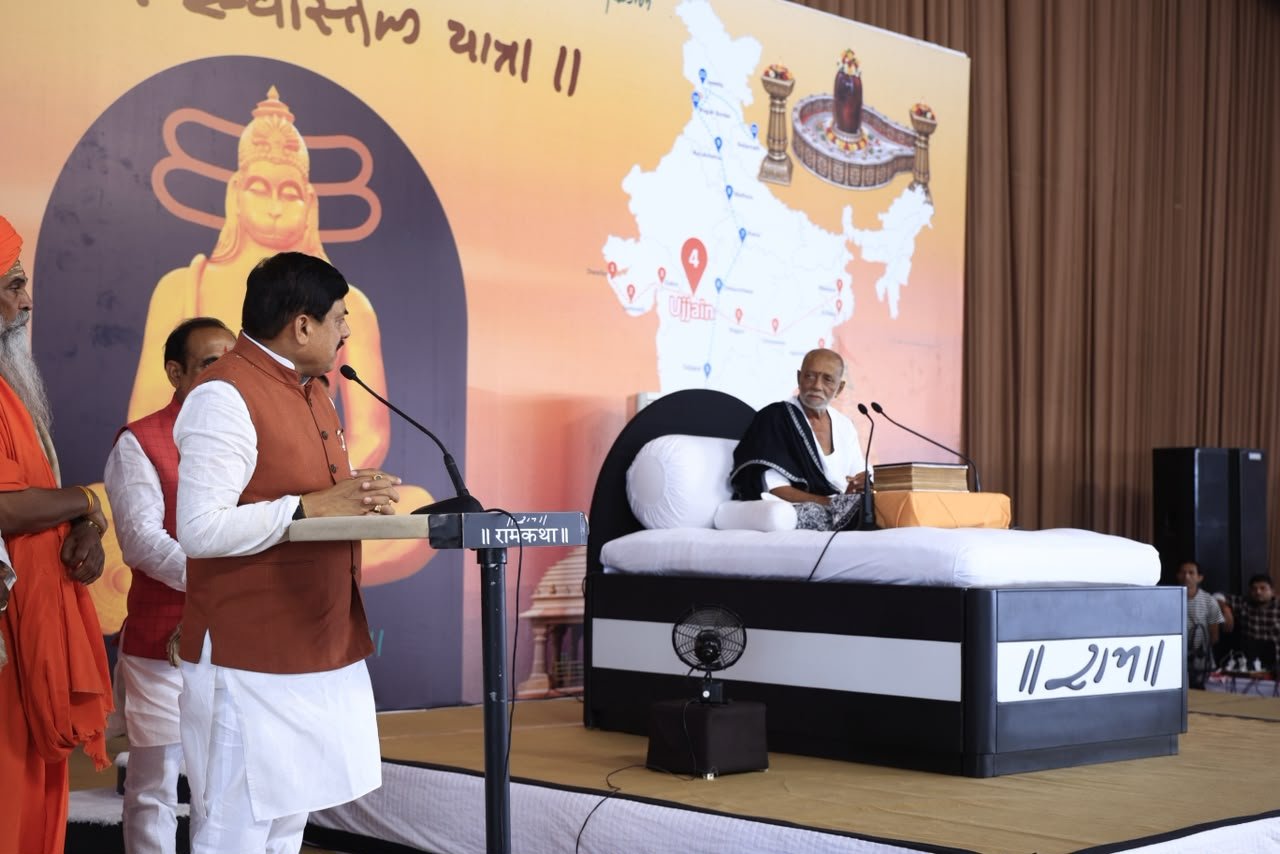
— At the sacred city of Mahakal, the Yatra brought attention to Ujjain’s significance as an ancient centre of spirituality, knowledge and India’s civilisational traditions.
UJJAIN, MADHYA PRADESH | 17th NOVEMBER 2026 | The Bharat Swastik Yatra, led by revered spiritual leader and Ramcharitmanas exponent Pujya Morari Bapu, reached Ujjain on November 17, where a Ram Katha was held as part of its second leg from Dwarka to Jagannath Puri. One of India’s oldest and most significant sacred cities, Ujjain holds a distinctive place in the spiritual geography of Bharat, bringing together traditions associated with Lord Shiva, Lord Krishna, ancient learning and India’s scientific heritage.
Madhya Pradesh Chief Minister Dr. Mohan Yadav visited the Bharat Swastik Yatra Ram Katha in Ujjain today and expressed his appreciation for Pujya Morari Bapu’s efforts to uphold the values of Sanatan Dharma and preserve India’s spiritual heritage.
Around 1000 devotees are accompanying Pujya Morari Bapu in the second phase of the Bharat Swastik Yatra aboard two special trains — Kailash Bharat Gaurav and Chitrakoot Bharat Gaurav, comprising 22 and 16 coaches respectively.
Pujya Morari Bapu said, “Pujya Morari Bapu said, “Ujjain’s Swastik is represented by four elements associated with Mahadev and Mahakaal: Bhasma, Bhiksha, Bhoot and Bhujang. These four elements reflect the divine essence of Mahadev. He said that, The essence of Shiv Tatva is ‘Sabka Svikaar Hi Shivatva Hai’ — true Shiv Tatva lies in accepting everyone. Acceptance are at the heart of Shivatva.
At the same time, those who do not respect Sanatan Dharma or stand in opposition to its traditions should not be permitted entry into its temples and sacred pilgrimage sites. Respect for the faith and its sacred institutions must remain paramount.”
Madhya Pradesh, Chief Minister, Dr. Mohan Yadav, who visited the Bharat Swastik Yatra Ram Katha in Ujjain today, said, “Ujjain is the sacred land of Baba Mahakal, where every breath reminds us of the preciousness of life and the importance of performing good deeds. It is a matter of great fortune that the Bharat Swastik Yatra and Ram Katha are taking place in this holy city, home to the Mahakaleshwar Jyotirlinga and the Sandipani Ashram, where Lord Krishna came to acquire knowledge. With the arrival of Pujya Morari Bapu and his Ram Katha, I feel that the Simhastha Ujjain Kumbh has already begun. On behalf of the Government of Madhya Pradesh, I extend my deepest respects to Pujya Morari Bapu for his efforts to uphold the values of Sanatan Dharma. Our government remains committed to preserving and developing the state’s sacred spiritual heritage.”
Organised by Santkripa Sanatan Sansthan, the Bharat Swastik Yatra seeks to connect India’s sacred geography and diverse cultural traditions through the enduring ideals of Sanatan Dharma.
Speaking about the significance of Ujjain in the Bharat Swastik Yatra, Madan Paliwal, Chairman, Miraj Group and Managing Trustee, Santkripa Sanatan Sansthan, said, “Ujjain holds a special place in India’s sacred geography as one of the seven Sapta Puri and a prominent destination of the Simhastha Kumbh Mela, which draws millions of devotees to the banks of the Kshipra. Home to the Mahakaleshwar Jyotirlinga, the city has remained a major centre of faith and spiritual traditions for centuries. Its place in the Yatra reflects the enduring importance of India’s ancient pilgrimage centres in preserving and carrying forward our civilisational heritage.”
At the heart of Ujjain’s spiritual identity is the Mahakaleshwar Temple, one of the twelve Jyotirlingas of Lord Shiva. Worshipped as Mahakal, the Lord of Time, Shiva is revered here as the supreme force beyond the cycle of time and mortality. According to the Shiva Purana, Lord Shiva manifested in Ujjain to protect his devotees from the demon Dushan, establishing his presence as the protector of the city. The temple’s distinctive Bhasma Aarti remains one of its most significant and recognised religious traditions, attracting devotees from across the country.
The Ramcharitmanas’s Uttar Kand refers to a Vedic Brahmin of Ujjain as a “Param Sadhu”, devoted to Lord Shiva and spiritual wisdom. The episode, recalled by Kakbhushundi, reflects the city’s association with Shaiva traditions and the spirit of harmony between different paths of devotion.
Together, the two phases of the Yatra, from Kanyakumari to Kedarnath and Dwarka to Jagannath Puri, cover 13 Indian states and the Union Territory of Jammu and Kashmir. The journey connects significant pilgrimage destinations, historical centres and regions associated with India’s diverse spiritual and cultural traditions.
Inspired by the Swastik, an ancient symbol of auspiciousness and well-being in Indian traditions, the Yatra carries the message of harmony, collective welfare and national integration. It also draws inspiration from Adi Shankaracharya, whose travels across Bharat helped connect diverse regions through the philosophical and spiritual traditions of Sanatan Dharma.
For Pujya Morari Bapu, whose Ram Kathas centre on Satya, Prem and Karuna — Truth, Love and Compassion — the Yatra extends these universal values across the country, bringing communities together through spirituality, dialogue and shared cultural heritage.
The Ram Katha and associated programmes during the Yatra are free of charge and open to all. Bhandara (vegetarian community meals) is organised at every location as prasad.
== ENDS ==

