

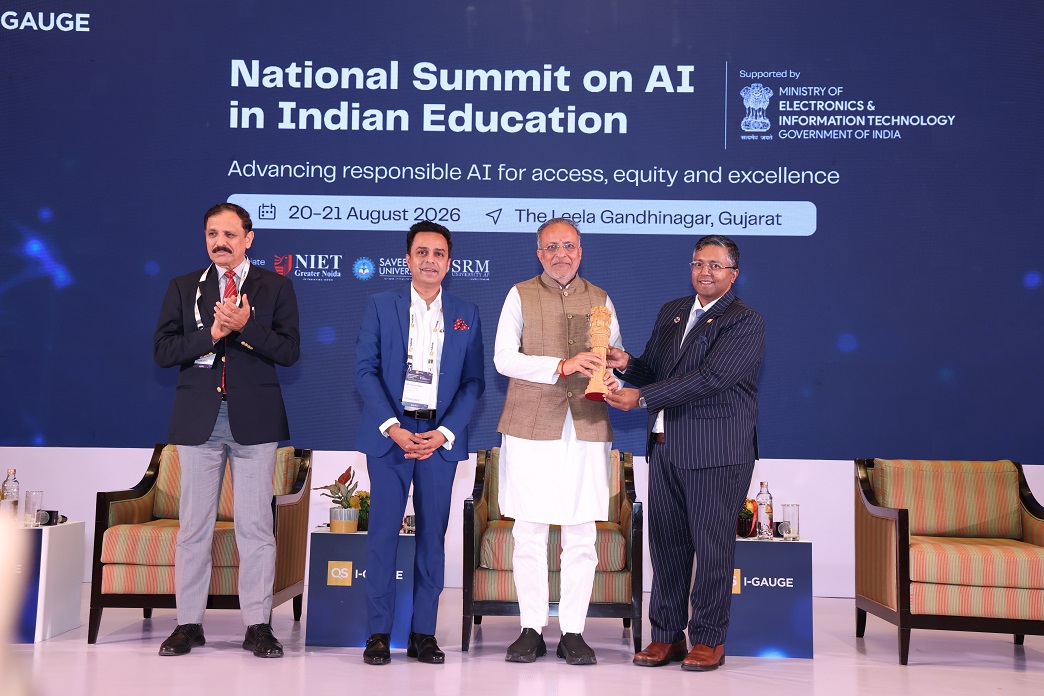
Education leaders, policymakers and technology experts deliberate on AI readiness, governance, academic integrity and the future of learning in India
GANDHINAGAR, GUJARAT | 21st AUGUST 2026 | As Artificial Intelligence continues to change the way in which students learnand institutions operate, the National Summit on AI in Indian Education, organised by QS I-GAUGE, brought together various stakeholders in the ecosystem to deliberate on how the country can move towards quality-driven AI adoption across higher education and K-12. QS I-GAUGE is India’s credible and independent educational institution rating and assessment system.
The Summit successfully moved the conversation beyond whether educational institutions should adopt AI and instead focused on how AI can be integrated responsibly, ethically and meaningfully.
Held under the theme ‘Advancing Responsible AI for Access, Equity and Excellence’, the two-day national summit brought together senior academic leaders, educationists, school leaders, policymakers, technology experts, quality assurance specialists and industry stakeholders to examine the opportunities and challenges emerging from the growing adoption of AI in education.
Shri Arjunbhai Devabhai Modhwadia, Hon’ble Minister, Science & Technology, Forests and Environment, Climate Change, Government of Gujarat, was the chief guest on day one for the valedictory ceremony.“AI adoption should be ethical and inclusive. As in all aspects of life, challenges and opportunities come hand in hand. Digital and AI literacy should mould the curriculum framework in our schools and colleges, moving forward. Let’s all prepare for an AI-first future by enabling our students to embrace AI tools through an enhanced curriculum,” he said.
The discussions assume particular significance as India stands at a defining stage in its AI journey. With the Government of India’s IndiaAI Mission, a national outlay of ₹10,372 crore, and increasing emphasis on future-ready skills, institutions are witnessing growing demand for AI-enabled teaching, learning, research, assessment and administration.
“AI is no longer a distant possibility for education, it is already influencing classrooms, campuses and institutional decision making. The priority now is to ensure that adoption is guided by purpose, responsibility and measurable educational outcomes. Institutions must not simply become AI-enabled; they must become AI-ready in a way that strengthens human capability and educational excellence,” Mr. Ravin Nair, Managing Director, QS I-GAUGE said.
Need for comprehensive frameworks
A key message that emerged from the Summit was that access to AI tools alone cannot be considered a measure of institutional readiness. Educational institutions need comprehensive frameworks covering governance, faculty and teacher preparedness, ethical use, data protection, academic integrity, assessment practices, inclusion and measurable impact.
“The future of AI in education will not be defined by algorithms alone, but by the frameworks that govern them. Then the teachers have to be empowered to use them and they need the skill and support to make AI work for every learner. Preparedness of the teachers is an important aspect and only then can AI become a force for meaningful learning,” said Dr. Ashwin Fernandes, Chair, QS India and VP, QS Quacquarelli Symonds.
Participants also discussed the need for institutions to move away from fragmented or ad-hoc technology adoption towards structured AI strategies aligned with their academic objectives and quality frameworks. Key areas of discussion included developing institutional AI policies and governance frameworks, redesigning assessment and evaluation in the era of Generative AI, protecting student and faculty data and digital rights and strengthening teacher and faculty capacity to work effectively with AI.The Summit also examined AI’s growing role in research and knowledge creation, with participants highlighting the importance of transparency, attribution, research integrity and responsible use of AI-generated content.
K-12 education: Building AI-ready schools while protecting children
The second day turned the spotlight on school education, with discussions on the unique opportunities and risks associated with introducing AI to children and young learners.
Participants underlined that AI adoption in schools must be approached differently from higher education, given the heightened importance of child safety, age-appropriate technology, data privacy, teacher preparedness, parental trust and human oversight. The discussions also stressed the importance of ensuring that AI does not undermine independent thinking, creativity, social interaction or the well-being of children.
The Summit also called for greater collaboration between educational institutions, government, technology companies, quality assurance bodies and educators to develop practical frameworks that can support institutions at different levels of AI maturity.
Recognising excellence in higher and school education, 91 institutions were awarded QS I-GAUGE rating certificates for meeting rigorous benchmarks of academic quality and educational standards.
== ENDS ==

